



 中
中

An aerial view of the Shuanglianpi Important Wetland, protected by Wistron Foundation for 16 years. (Photo: Tsung-yi Lin)
Strengthening Habitat Protection and Restoration: A Lasting Environmental Commitment
Since its establishment, the Foundation has adhered to an altruistic philosophy, dedicating itself to long-term and continuous habitat conservation. In terms of habitat protection, we have sponsored the Society of Wilderness's "Shuanglianpi Habitat Restoration Long-Term Project" for 16 years, working to safeguard its natural floating island ecosystem and restore native aquatic plants. We have supported the Tainan Community University Environmental Group in executing two projects—the "Taiwan Territory Protection Plan" and "Parks, Trees, and the City"—tracking improper industrial waste dumping for 15 years, managing an ecological demonstration habitat in the century-old Tainan Park for 13 years, and protecting the Longci Niupu Badlands landscape for 9 years. Additionally, for four years we collaborated with the Wild Bird Society of Taipei on the "Moon Pond Adoption and Waterfowl Breeding Habitat Conservation Plan, " adopting the core waterfowl habitat area and Moon Pond—a haven for freshwater fish restoration—at Guandu Nature Park. By 2026, the Foundation had protected a total habitat area of 31.67 hectares.
We place equal importance on professional expertise and scientific monitoring alongside our financial and corporate volunteer commitments. Through continuous ecological research and surveys, we track dynamic habitat changes and convene expert panel discussions with ecologists to continually adapt our conservation strategies. In 2025 alone, we conducted 96 ecological surveys, held the Shuanglianpi Wetland Expert Consultation, and safeguarded 53 target species—including 19 plant species listed on the Red List of Threatened Species and 10 protected wildlife species.
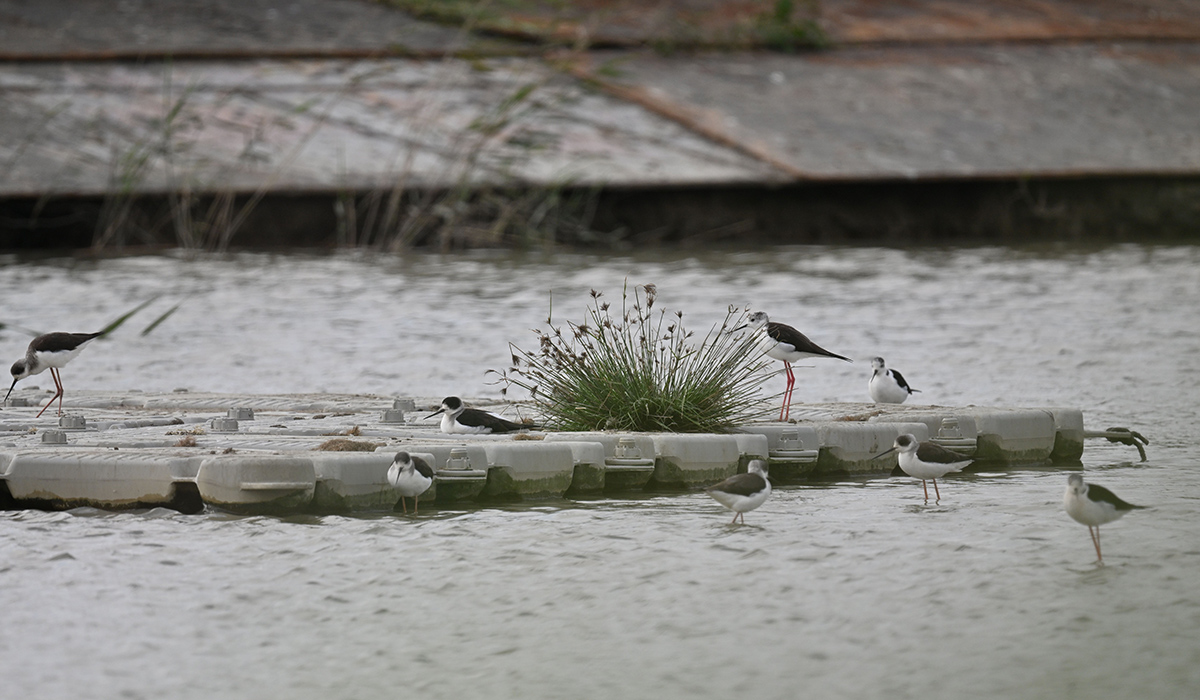
Supported the creation of small islands at Guandu Nature Park to provide breeding habitat for black-winged stilts. (Photo: Chih-ming Chiang, Volunteer, Wild Bird Society of Taipei)
Advancing Rescue Across Land, Sea, and Air: Breaking Through Conservation Bottlenecks with Scientific Research
While safeguarding habitat integrity, we simultaneously monitor wildlife population health and the impacts of human activity on individual animals. Since 2021, we have supported the conservation and rescue initiatives of both the WildOne Wildlife Conservation Association (WildOne) and the Raptor Research Group of Taiwan (RRGT). In 2025 alone, these efforts helped rescue 843 wild animals—including 406 protected species—and successfully release 339 back into the wild. Admission data compiled by these rescue centers reveals a steady year-over-year rise in cases resulting from free-roaming dog and cat attacks. To address this issue, we partnered with WildOne to launch a three-year "Free-roaming Dogs and Cats Environmental Survey." By combining population counts with resident surveys, the project analyzes the root causes of local stray animals populations to inform municipal policy and guide targeted environmental education. This research model was subsequently expanded to the Longci Badlands—a site protected alongside the Tainan Community University—using scientific data to build local consensus and prompt local authorities to strengthen dog management measures, thereby easing survival pressures on the area's pangolin population.
In 2025, the foundation further expanded its rescue efforts into marine conservation by sponsoring Professor Wei-cheng Yang of the Conservation Medicine Laboratory under the School of Veterinary Medicine at National Taiwan University to execute the "Cetacean Health Promotion and Cross-Border Conservation Research Project." This initiative not only rescues stranded cetaceans, but also utilizes accumulated physiological samples to investigate the underlying causes of strandings. Furthermore, it develops a rapid screening tool for cetacean morbillivirus—a pathogen that severely impacts cetacean immunity—providing frontline conservationists with a precise, rapid, and cost-effective diagnostic tool to bridge the data gaps caused by budget and technical constraints in rescue operations.
Supporting International Academic Exchanges to Share Experience and Technologies with the World
We extended the impact of our supported projects to an international scale. In 2025, the Foundation sponsored the Raptor Research Group of Taiwan to host the "13th ARRCN & 7th Taiwan Raptor Symposium" (referred to as the Asian Raptor Symposium), marking the event's first in-person gathering post-pandemic. The symposium brought together 323 participants from 16 countries, featuring 53 oral presentations on topics spanning population ecology monitoring, genetics, and national conservation actions. In parallel, the outcomes of WildOne's Free-Roaming Dog and Cat Environmental Survey Project were presented in November 2025 at the Wild Animal Rescue Network Asia (WARN Asia) Conference, sharing Taiwan’s experience with 47 rescue and conservation organizations across 19 countries. Furthermore, through the "Cetacean Health Promotion and Cross-Border Research and Conservation Project," we shared Taiwan's proprietary rapid screening technology for cetacean morbillivirus with international conservation partners in the Philippines and Malaysia to jointly safeguard the health of these transboundary marine species.
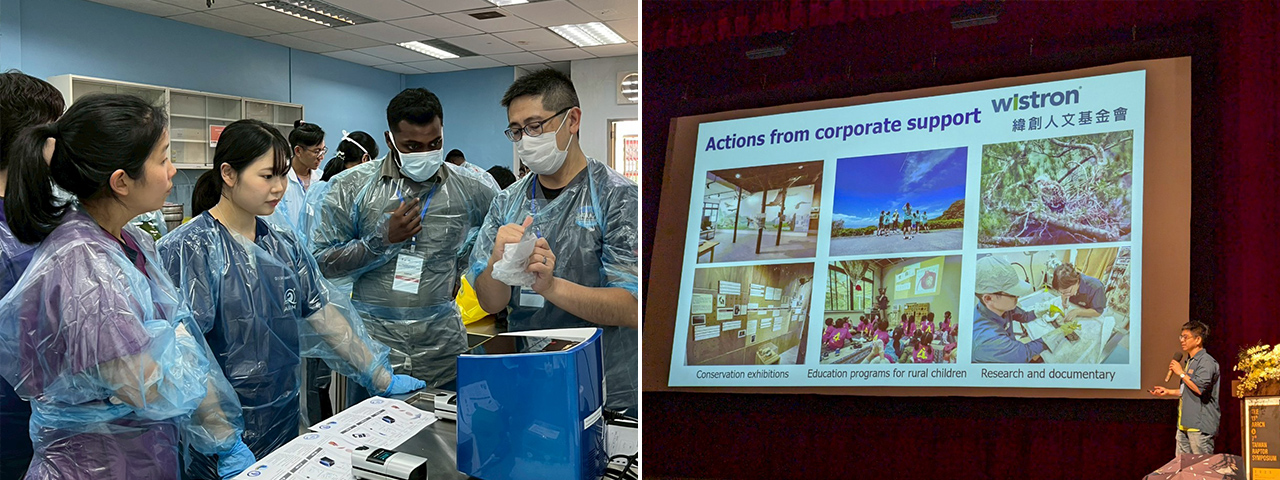
Left: The foundation supports a cetacean conservation project to share cetacean disease detection technology with international conservation partners. Right: Dr. Si-min Lin, Chair of the Asian Raptor Symposium organizing committee, introduces the conservation partnership between Wistron Foundation and the Raptor Research Group of Taiwan.
The Foundation lays the groundwork for sustainability through long-term commitment by sponsoring ecological organizations, scientific research, and international collaborative projects. We continuously advance habitat conservation, wildlife rescue, and population health studies, aiming to drive positive, impactful conservation outcomes rooted in science and local partnerships.