



 中
中
Reflecting on Seven Years of Shuanglianpi Conservation at the 2025 Jeju Forum
By Guan-Bo Huang
Before graduating last year, I discovered that the Taiwan Ecological Research Network (TERN) was recruiting students for the International Ecology School. This is an annual event held in different Asian countries, where professors specializing in long-term ecological research lead young researchers to learn about the field and exchange ideas with peers of their generation. Last year, it was held on Jeju Island, South Korea. Drawn by the opportunity to travel abroad for free and gain a deep understanding of international ecological research, I quickly prepared my CV and was fortunate enough to be selected. My selling points in the CV were my training in a long-term ecological research lab and my seven years of local involvement at Shuanglianpi. Unfortunately, I was unable to give a proper presentation at the event because I was preparing for my thesis defense. To my surprise, an assistant from the International Ecology School in Korea sent a message in early April; they were looking for students who participated last year to attend the Jeju Forum and share their experiences of the program.
For our session, the forum had suggested several presentation themes: introducing long-term ecological research in one's own country, the management of invasive species on islands, or national investment in ecological conservation research. Once the presentation themes were settled, it felt like an electric shock—seeing "island invasive species management," I knew with absolute certainty that I had to bring everyone's hard work at Shuanglianpi over the past few years onto the global stage.
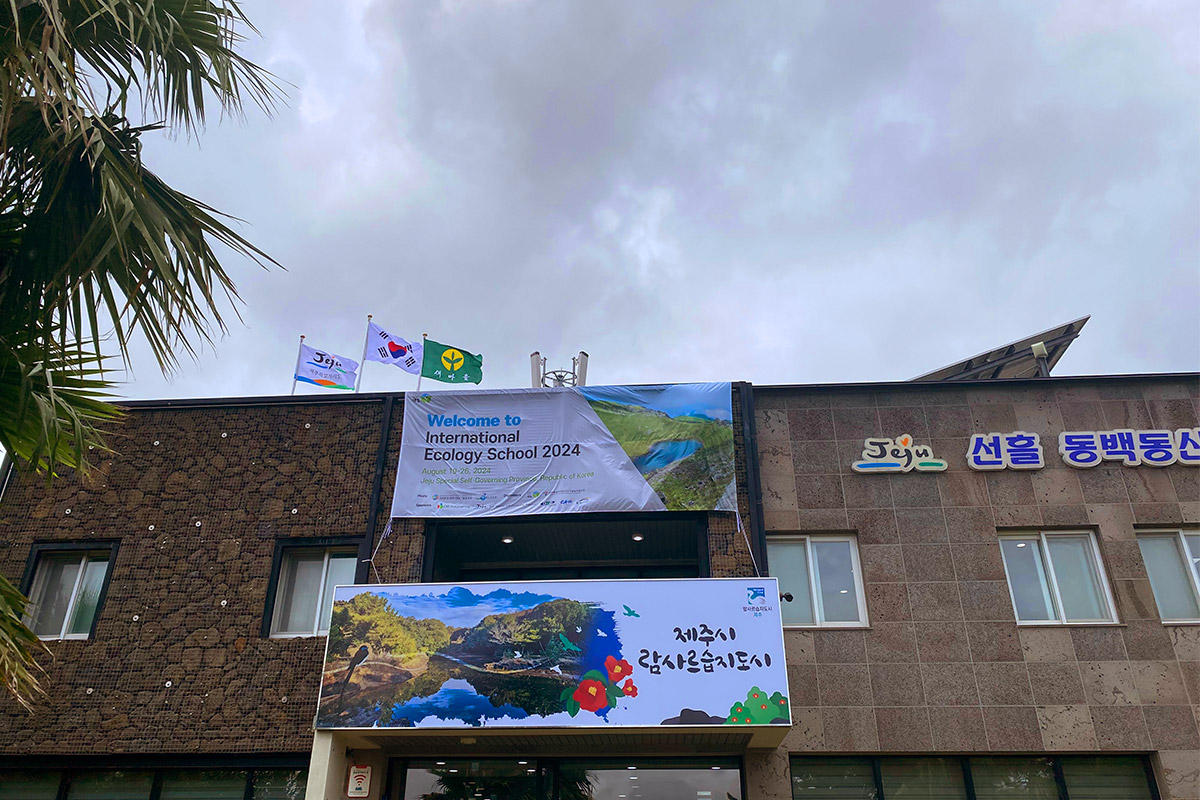
International Eco-Schools held in Jeju, 2024
Marking its 20th anniversary, the Jeju Forum was originally established to position Jeju as a neutral, peaceful platform for international exchange; today, it has evolved into a premier regional conference for East Asia. This year’s theme, "Harnessing Innovation for Peace and Shared Prosperity," arrives amid escalating global tensions, deteriorating U.S.-China relations, the regulatory and economic impacts of rapidly advancing AI, and a worsening climate crisis—all presenting the world with unprecedented challenges. In response, the forum centered its discussions on geopolitics, the climate-environment, and the tech economy. Falling under the climate-environment track, my presentation brought together emerging researchers from last year’s International Ecology School in Jeju to discuss our respective countries' engagement in long-term ecological and biodiversity efforts.

Theme of the 2025 Jeju Forum
Perhaps because our hosts are also an island, "island invasive species management" was carved out as a specific presentation theme. With my fellow panelist, a PhD researcher from the Philippines, sharing studies that spanned the Philippine archipelago, it was clear the organizers genuinely sought practical case studies to inform island conservation policies. Restoring a degraded island ecosystem is a monumental challenge. The confined space and limited resources of an island, coupled with the unique species evolution driven by geographic isolation, mean that unlike mainland ecosystems, there are no neighboring seed sources to accelerate recovery after a disturbance. This makes island ecosystems exceptionally fragile. Yet, "islands" are more ubiquitous than we think. An island’s vulnerability stems from being enveloped by a completely different ecosystem. In this light, we can define an "island" as any ecological pocket heterogeneous to its surroundings—much like Shuanglianpi and its fellow low-elevation ponds. They are, in essence, a cluster of tiny islands floating within the Yilan forests, cradled by the surrounding mountains and hills.
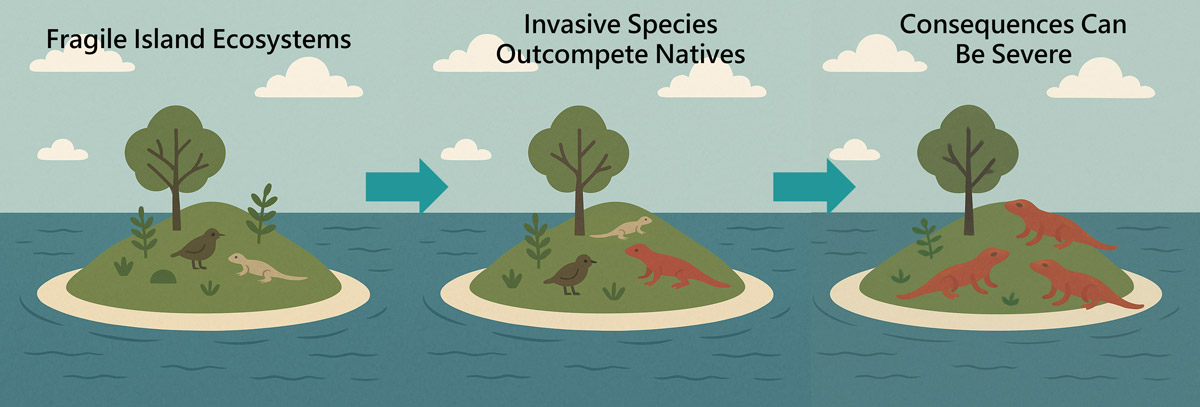
The consequences of failed competition against invasive species in island ecosystems.
Back in my sophomore year, I had just met Hung-Yi Huang, who now serves as a full-time staff member for the Society of Wilderness at Shuanglianpi. Like many nature-loving ecology majors back then, I wanted nothing more than to spend every waking hour immersed in the wild. Hung-Yi had led several of our department's outdoor field surveys, always blending captivating storytelling with deep professionalism. Watching him speak of various species with such effortless familiarity—guiding us to savor the wonder of each detail as if uncovering buried treasure—our cohort of underclassmen was utterly captivated, and many of us were inspired to embark on our own paths in ecological research. During one of these trips, Hung-Yi invited a group of us to Shuanglianpi in Yilan. For someone like me, who had spent the first 18 years of life in the city—loving nature yet remaining a stranger to it—this place allowed me to truly reconnect with the natural world. Though its environment was only beginning to gradually recover at the time, Shuanglianpi was already brimming with charm. What captivated me most were the myriad rare aquatic plants scattered throughout, some floating gracefully and others submerged; certain species even clustered together to form a floating island that drifted across the lake. It was love at first sight, and they eventually became the focus of my later research. Looking back today, that immersive experience remains unforgettable—it is the very spark that continues to fuel my journey in the field of ecology.
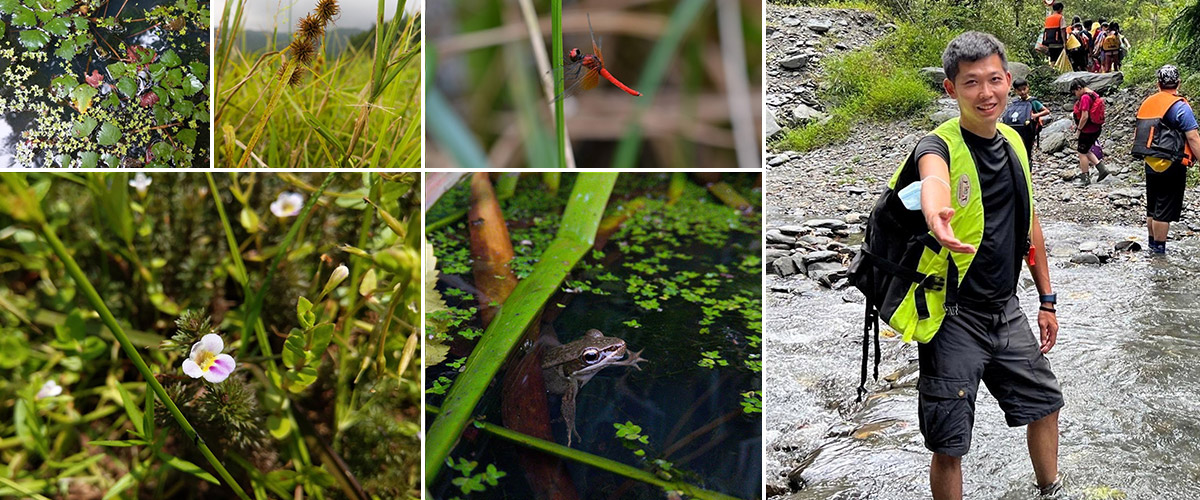
The rich biodiversity of Shuanglianpi and Hung-Yi’s passion have inspired generations of NTNU Life Science students to embark on their ecological journeys.
The environmental crisis at Shuanglianpi dates back to 2000, when landowner attempted to develop the lake area; the heavy use of excavators and herbicides triggered a severe ecological degradation. This was far more than a loss of biodiversity—it was a systemic collapse of ecosystem functioning. In a healthy ecosystem, invasive species rarely find an easy foothold; native species fully occupy their ecological niches, possessing the resilience to fend off new arrivals. However, when anthropogenic disturbances leave empty ecological pockets waiting to recover, these opportunistic invaders seize the gamble, infiltrating the vulnerable spaces. Because a degraded environment lacks functional integrity, its recovery time after subsequent disturbances is prolonged, leaving a wider window for invasions to succeed—which is precisely how the giant salvinia (Salvinia molesta) gained its foothold in Shuanglianpi. In mid-2019, while the lake’s native aquatic flora was still awaiting our restoration efforts, giant salvinia made its first appearance. Exploiting the unoccupied space and resources, it escalated from sporadic sightings to completely carpet the northeast pond in just six months. Yet, despite this aggressive invasion, Shuanglianpi remained a sanctuary for numerous rare aquatic plants. Because of its designation as an "Important Wetland," strict legal regulations prohibited the use of heavy machinery, leaving us entirely reliant on manual labor. The sheer volume of giant salvinia was staggering; despite the Society of Wilderness organizing consecutive volunteer days that spring, we could barely scratch the surface. That was when Hung-Yi realized we could bridge education with hands-on conservation. He approached me to organize a dedicated event, rallying a passionate crew of underclassmen from our department. Mobilizing 20 to 30 people at a time, we deployed a "human-wave tactic" to confront a literal sea of salvinia.
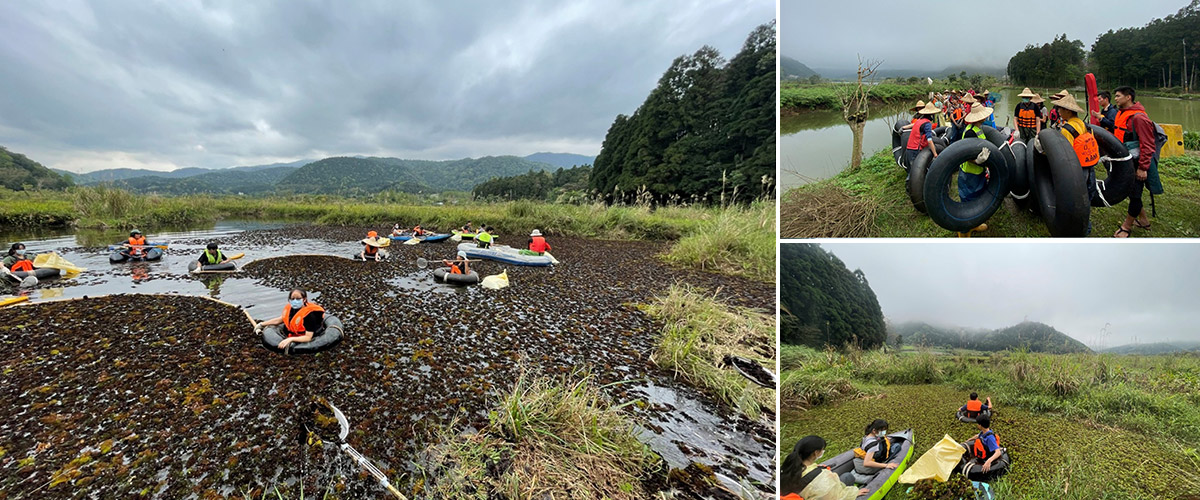
The massive mobilization of NTNU Life Science students in invasive species removal.
Eradicating invasive species is never a swift process. As giant salvinia matures, it produces an abundance of sporocarp that eventually detach from the basal leaves and sink into the mud, leaving behind a massive, dormant "standby force." Although we cleared the lake surface time and time again, the process repeated itself in an endless loop—as long as these sporocarps in the soil spore bank had not fully germinated and been removed, they would grow back with a vengeance, a relentless cycle akin to the boulder of Sisyphus. Witnessing this endless repetition for so long was admittedly disheartening. Yet, we refused to give up, pushing through six long years. In 2024, we noticed a dramatic shift: the total volume removed over the entire year was significantly lower than ever before. It was a textbook ecological phenomenon unfolding before our eyes—when a population drops below its minimum viable size, it naturally collapses. This signal proudly announced that our war against the giant salvinia had drawn to a close; we had achieved complete eradication, a feat exceedingly rare in the real-world management of invasive species.
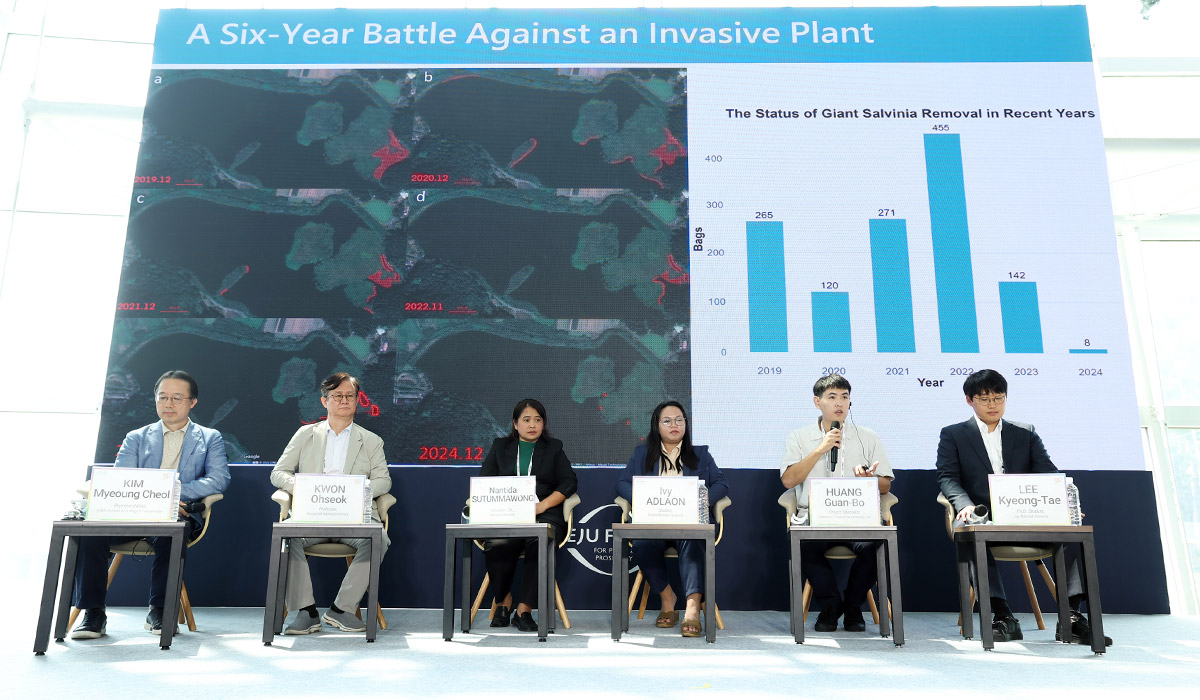
The author presenting the data on giant salvinia's coverage and removal trends at Shuanglianpi during the 2025 Jeju Forum.
The resounding success of invasive species management at Shuanglianpi is indeed a rare and remarkable feat. While built upon the tireless, hands-on efforts of volunteers over the past six years, its true foundation lies in a comprehensive collaborative ecosystem, seamlessly connected by the Society of Wilderness. Leveraging its extensive experience with the public sector, the Society facilitated seamless communication among key stakeholders—including the Yilan County Government, the Forestry and Nature Conservation Agency, and the Taiwan Forestry Research Institute—effectively navigating policy obstacles and administrative hurdles. Concurrently, trusted academic partners like NTNU, NTU, and NIU have provided rigorous research to guide our conservation strategies, ensuring every action is firmly grounded in science and kept on the right track. Furthermore, the Wistron Foundation has anchored these long-term efforts with holistic financial and structural support, serving as our most steadfast backbone. Within this vast network, Hung-Yi and I are merely small nodes. By organizing activities, I channel fresh human resources into the field, while Hung-Yi fosters our ecological capacity and fulfills operational needs. This symbiotic relationship continues to be passed down through generations of our department, cultivating a sustainable lifeline of passionate advocates for the future of Shuanglianpi.
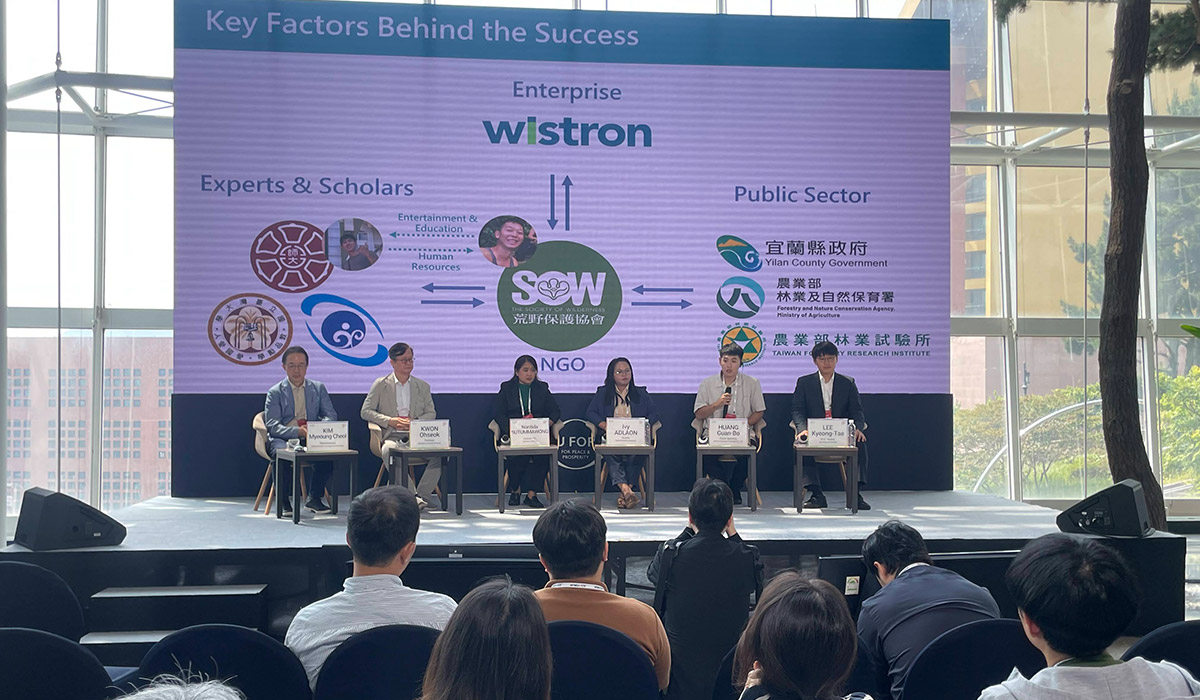
The author illustrating the collaborative partnerships behind the Shuanglianpi conservation actions at the 2025 Jeju Forum.
Reflecting on this journey to Jeju Island, I realized that while our conservation efforts in Taiwan have already achieved remarkable milestones, there is still much to learn from South Korea and Jeju. As a cornerstone of South Korea's ecological conservation, Jeju is a unique sanctuary—boasting UNESCO World Natural Heritage, Biosphere Reserve, Global Geopark, and Intangible Cultural Heritage designations, alongside Ramsar wetlands. This dense concentration makes Jeju a textbook example of a Multiple Internationally Designated Area. Gazing upon Jeju's vibrant ecology and deep-rooted culture, my thoughts invariably drifted back to my hometown 1,000 kilometers away. Though the harsh realities of international politics deny Taiwan the global certifications and protections bestowed upon Jeju, we have nevertheless relied on our own strength to safeguard our unique ecosystems and heritage, persisting against the odds. The eradication of giant salvinia at Shuanglianpi is far more than a positive success story of invasive species management; it underscores that the long-term stewardship of critical sanctuaries hinges entirely on a cross-sector alliance. Only when the public and private sectors, academia, and environmental groups walk hand-in-hand can conservation actions truly endure. It is my sincere hope that this collaborative model will flourish across Taiwan—ensuring that as our industries advance, we cultivate a more resilient natural environment for generations to come.
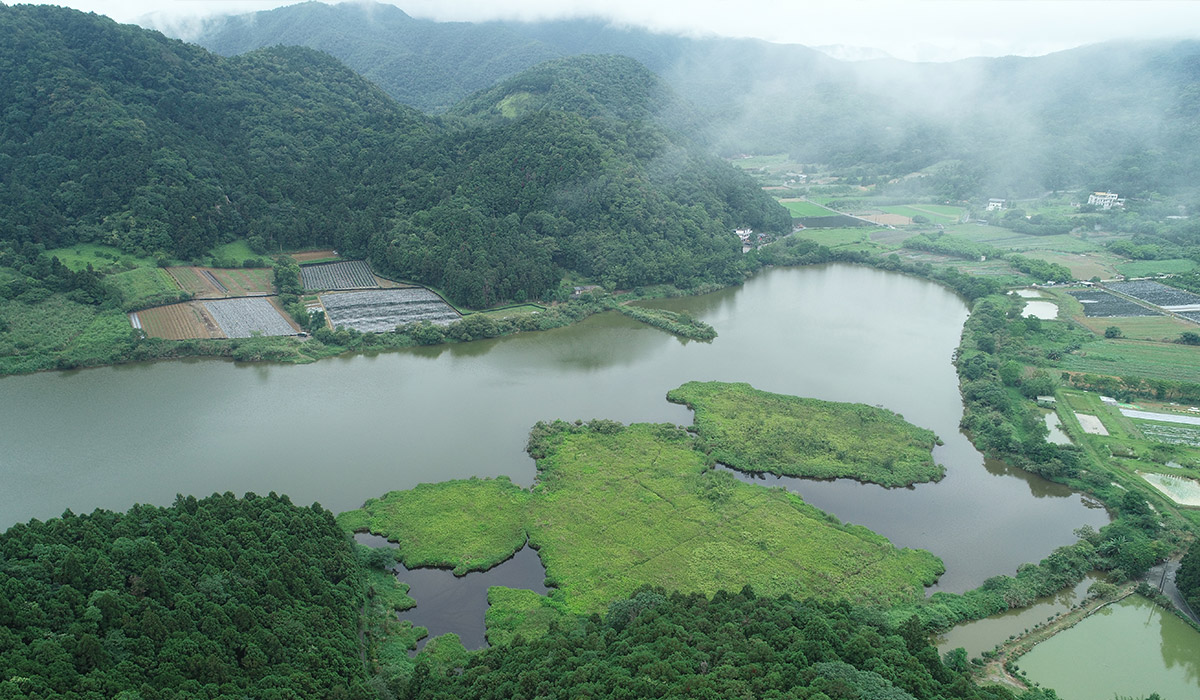
An aerial view of the largest natural floating island in Taiwan, nestled within the Shuanglianpi lake area.
About the Author
Kuan-Po Huang Project Specialist, Conservation and Planning Department I, Observer Ecological Consultant Co., Ltd. Master of Science, Ecology and Evolutio, Department of Life Science, National Taiwan Normal University Long-term Volunteer, Shuanglianpi Environmental Education and Habitat Conservation Base